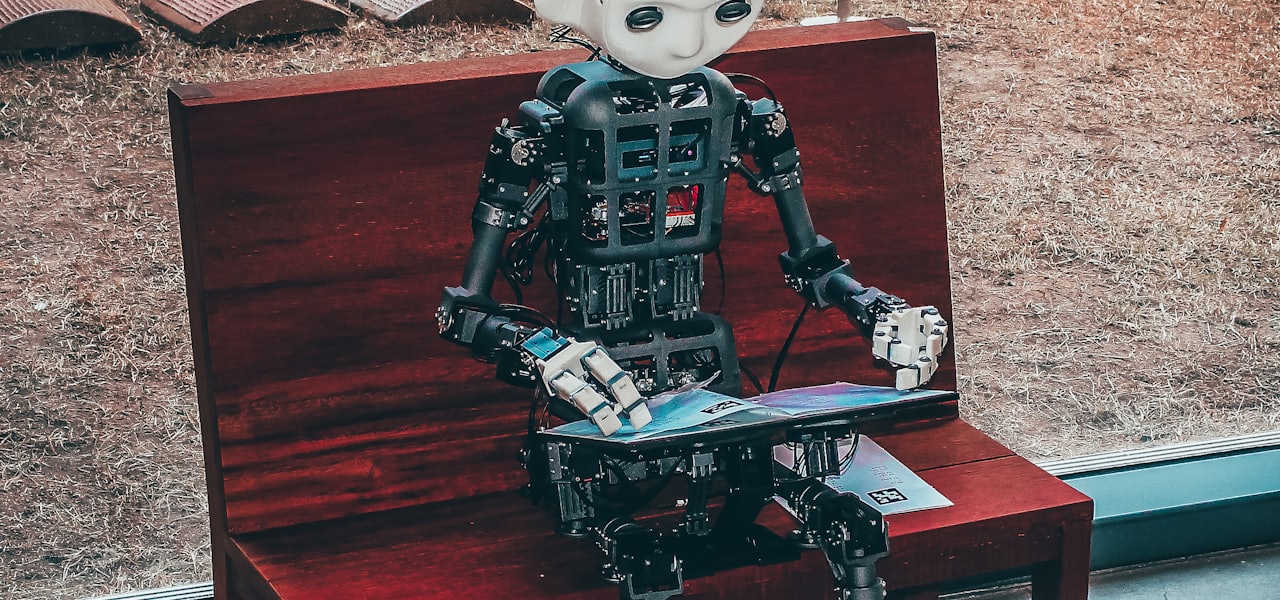
Speech synthesis is the artificial production of human speech. A computer system used for this purpose is called a speech synthesizer, and can be implemented in software or hardware products. A text-to-speech (TTS) system converts normal language text into speech; other systems render symbolic linguistic representations like phonetic transcriptions into speech. The reverse process is speech recognition. Synthesized speech can be created by concatenating pieces of recorded speech that are stored in a database. Systems differ in the size of the stored speech units; a system that stores phones or diphones provides the largest output range, but may lack clarity. For specific usage domains, the storage of entire words or sentences allows for high-quality output. Alternatively, a synthesizer can incorporate a model of the vocal tract and other human voice characteristics to create a completely "synthetic" voice output. The quality of a speech synthesizer is judged by its similarity to the human voice and by its ability to be understood clearly. An intelligible text-to-speech program allows people with visual impairments or reading disabilities to listen to written words on a home computer. The earliest computer operating system to have included a speech synthesizer was Unix in 1974, through the Unix speak utility. In 2000, Microsoft Sam was the default text-to-speech voice synthesizer used by the narrator accessibility feature, which shipped with all Windows 2000 operating systems, and subsequent Windows XP systems. A text-to-speech system (or "engine") is composed of two parts: a front-end and a back-end. The front-end has two major tasks. First, it converts raw text containing symbols like numbers and abbreviations into the equivalent of written-out words. This process is often called text normalization, pre-processing, or tokenization. The front-end then assigns phonetic transcriptions to each word, and divides and marks the text into prosodic units, like phrases, clauses, and sentences. The process of assigning phonetic transcriptions to words is called text-to-phoneme or grapheme-to-phoneme conversion. Phonetic transcriptions and prosody information together make up the symbolic linguistic representation that is output by the front-end. The back-end—often referred to as the synthesizer—then converts the symbolic linguistic representation into sound. In certain systems, this part includes the computation of the target prosody (pitch contour, phoneme durations), which is then imposed on the output speech. == History == Long before the invention of electronic signal processing, some people tried to build machines to emulate human speech. There were also legends of the existence of "Brazen Heads", such as those involving Pope Silvester II (d. 1003 AD), Albertus Magnus (1198–1280), and Roger Bacon (1214–1294). In 1779, the German-Danish scientist Christian Gottlieb Kratzenstein won the first prize in a competition announced by the Russian Imperial Academy of Sciences and Arts for models he built of the human vocal tract that could produce the five long vowel sounds (in International Phonetic Alphabet notation: [aː], [eː], [iː], [oː] and [uː]). There followed the bellows-operated "acoustic-mechanical speech machine" of Wolfgang von Kempelen of Pressburg, Hungary, described in a 1791 paper. This machine added models of the tongue and lips, enabling it to produce consonants as well as vowels. In 1837, Charles Wheatstone produced a "speaking machine" based on von Kempelen's design, and in 1846, Joseph Faber exhibited the "Euphonia". In 1923, Paget resurrected Wheatstone's design. In the 1930s, Bell Labs developed the vocoder, which automatically analyzed speech into its fundamental tones and resonances. From his work on the vocoder, Homer Dudley developed a keyboard-operated voice-synthesizer called The Voder (Voice Demonstrator), which he exhibited at the 1939 New York World's Fair. Franklin S. Cooper and his colleagues at Haskins Laboratories built the pattern playback in the late 1940s and completed it in 1950. There were several different versions of this hardware device; only one currently survives. The machine converts pictures of the acoustic patterns of speech in the form of a spectrogram back into sound. Using this device, Alvin Liberman and colleagues discovered acoustic cues for the perception of phonetic segments (consonants and vowels). === Electronic devices === The first computer-based speech-synthesis systems originated in the late 1950s. Noriko Umeda et al. developed the first general English text-to-speech system in 1968, at the Electrotechnical Laboratory in Japan. In 1961, physicist John Larry Kelly, Jr and his colleague Louis Gerstman used an IBM 704 computer to synthesize speech, an event among the most prominent in the history of Bell Labs. Kelly's voice recorder synthesizer (vocoder) recreated the song "Daisy Bell", with musical accompaniment from Max Mathews. Coincidentally, Arthur C. Clarke was visiting his friend and colleague John Pierce at the Bell Labs Murray Hill facility. Clarke was so impressed by the demonstration that he used it in the climactic scene of his screenplay for his novel 2001: A Space Odyssey, where the HAL 9000 computer sings the same song as astronaut Dave Bowman puts it to sleep. Despite the success of purely electronic speech synthesis, research into mechanical speech-synthesizers continues. Linear predictive coding (LPC), a form of speech coding, began development with the work of Fumitada Itakura of Nagoya University and Shuzo Saito of Nippon Telegraph and Telephone (NTT) in 1966. Further developments in LPC technology were made by Bishnu S. Atal and Manfred R. Schroeder at Bell Labs during the 1970s. LPC was later the basis for early speech synthesizer chips, such as the Texas Instruments LPC Speech Chips used in the Speak & Spell toys from 1978. In 1975, Fumitada Itakura developed the line spectral pairs (LSP) method for high-compression speech coding, while at NTT. From 1975 to 1981, Itakura studied problems in speech analysis and synthesis based on the LSP method. In 1980, his team developed an LSP-based speech synthesizer chip. LSP is an important technology for speech synthesis and coding, and in the 1990s was adopted by almost all international speech coding standards as an essential component, contributing to the enhancement of digital speech communication over mobile channels and the internet. In 1975, MUSA was released, and was one of the first Speech Synthesis systems. It consisted of a stand-alone computer hardware and a specialized software that enabled it to read Italian. A second version, released in 1978, was also able to sing Italian in an "a cappella" style. Dominant systems in the 1980s and 1990s were the DECtalk system, based largely on the work of Dennis Klatt at MIT, and the Bell Labs system; the latter was one of the first multilingual language-independent systems, making extensive use of natural language processing methods. Handheld electronics featuring speech synthesis began emerging in the 1970s. One of the first was the Telesensory Systems Inc. (TSI) Speech+ portable calculator for the blind in 1976. Other devices had primarily educational purposes, such as the Speak & Spell toy produced by Texas Instruments in 1978. Fidelity released a speaking version of its electronic chess computer in 1979. The first video game to feature speech synthesis was the 1980 shoot 'em up arcade game, Stratovox (known in Japan as Speak & Rescue), from Sun Electronics. The first personal computer game with speech synthesis was Manbiki Shoujo (Shoplifting Girl), released in 1980 for the PET 2001, for which the game's developer, Hiroshi Suzuki, developed a "zero cross" programming technique to produce a synthesized speech waveform. Another early example, the arcade version of Berzerk, also dates from 1980. The Milton Bradley Company produced the first multi-player electronic game using voice synthesis, Milton, in the same year. In 1976, Computalker Consultants released their CT-1 Speech Synthesizer. Designed by D. Lloyd Rice and Jim Cooper, it was an analog synthesizer built to work with microcomputers using the S-100 bus standard. Synthesized voices typically sounded male until 1990, when Ann Syrdal, at AT&T Bell Laboratories, created a female voice. Ray Kurzweil predicted in 2005 that as the cost-performance ratio caused speech synthesizers to become cheaper and more accessible, more people would benefit from the use of text-to-speech programs. === Artificial intelligence === In September 2016, DeepMind released WaveNet, which demonstrated that deep learning models are capable of modeling raw waveforms and generating speech from acoustic features like spectrograms or mel-spectrograms, starting the field of deep learning speech synthesis. Although WaveNet was initially considered to be computationally expensive and slow to be used in consumer products at the time, a year after its
Desktop video
Desktop video refers to a phenomenon lasting from the mid-1980s to the early 1990s when the graphics capabilities of personal computers such as the Amiga, Macintosh II, and specially-upgraded IBM PC compatibles had advanced to the point where individuals and local broadcasters could use them for analog non-linear editing and vision mixing in video production. Despite the use of computers, desktop video should not be confused with digital video since the video data remained analog, and it uses items like a VCR and a camcorder to record the video. Full-screen, full-motion video's vast storage requirements meant that the promise of digital encoding would not be realized on desktop computers for at least another decade. == Description == There were multiple models of genlock cards available to synchronize the content; the Newtek Video Toaster was commonly used in Amiga in countries that used NTSC (PAL-M in Brazil), while PCs had Truevision and Matrox Illuminator cards and Mac systems had the SuperMac Video Spigot and Radius VideoVision cards. Apple later introduced the Macintosh Quadra 840AV and Centris 660AV systems to specifically address this market. Desktop video was a parallel development to desktop publishing and enabled many small production houses and local TV stations to produce their own original content for the first time. Along with the advent of public-access cable channels, desktop video meant that television advertising became affordable for local businesses such as retailers, restaurants, real estate agents, contractors and auto dealers. As with the phrase desktop publishing, use of the term died out as the technologies to which it referred become the norm for any kind of video production.
Human image synthesis
Human image synthesis is technology that can be applied to make believable and even photorealistic renditions of human-likenesses, moving or still. It has effectively existed since the early 2000s. Many films using computer generated imagery have featured synthetic images of human-like characters digitally composited onto the real or other simulated film material. Towards the end of the 2010s deep learning artificial intelligence has been applied to synthesize images and video that look like humans, without need for human assistance, once the training phase has been completed, whereas the old school 7D-route required massive amounts of human work. == Timeline of human image synthesis == In 1971 Henri Gouraud made the first CG geometry capture and representation of a human face. Modeling was his wife Sylvie Gouraud. The 3D model was a simple wire-frame model and he applied the Gouraud shader he is most known for to produce the first known representation of human-likeness on computer. The 1972 short film A Computer Animated Hand by Edwin Catmull and Fred Parke was the first time that computer-generated imagery was used in film to simulate moving human appearance. The film featured a computer simulated hand and face (watch film here). The 1976 film Futureworld reused parts of A Computer Animated Hand on the big screen. The 1983 music video for song Musique Non-Stop by German band Kraftwerk aired in 1986. Created by the artist Rebecca Allen, it features non-realistic looking, but clearly recognizable computer simulations of the band members. The 1994 film The Crow was the first film production to make use of digital compositing of a computer simulated representation of a face onto scenes filmed using a body double. Necessity was the muse as the actor Brandon Lee portraying the protagonist was tragically killed accidentally on-stage. In 1999 Paul Debevec et al. of USC captured the reflectance field of a human face with their first version of a light stage. They presented their method at the SIGGRAPH 2000 In 2003 audience debut of photo realistic human-likenesses in the 2003 films The Matrix Reloaded in the burly brawl sequence where up-to-100 Agent Smiths fight Neo and in The Matrix Revolutions where at the start of the end showdown Agent Smith's cheekbone gets punched in by Neo leaving the digital look-alike unnaturally unhurt. The Matrix Revolutions bonus DVD documents and depicts the process in some detail and the techniques used, including facial motion capture and limbal motion capture, and projection onto models. In 2003 The Animatrix: Final Flight of the Osiris a state-of-the-art want-to-be human likenesses not quite fooling the watcher made by Square Pictures. In 2003 digital likeness of Tobey Maguire was made for movies Spider-man 2 and Spider-man 3 by Sony Pictures Imageworks. In 2005 the Face of the Future project was an established. by the University of St Andrews and Perception Lab, funded by the EPSRC. The website contains a "Face Transformer", which enables users to transform their face into any ethnicity and age as well as the ability to transform their face into a painting (in the style of either Sandro Botticelli or Amedeo Modigliani). This process is achieved by combining the user's photograph with an average face. In 2009 Debevec et al. presented new digital likenesses, made by Image Metrics, this time of actress Emily O'Brien whose reflectance was captured with the USC light stage 5 Motion looks fairly convincing contrasted to the clunky run in the Animatrix: Final Flight of the Osiris which was state-of-the-art in 2003 if photorealism was the intention of the animators. In 2009 a digital look-alike of a younger Arnold Schwarzenegger was made for the movie Terminator Salvation though the end result was critiqued as unconvincing. Facial geometry was acquired from a 1984 mold of Schwarzenegger. In 2010 Walt Disney Pictures released a sci-fi sequel entitled Tron: Legacy with a digitally rejuvenated digital look-alike of actor Jeff Bridges playing the antagonist CLU. In SIGGGRAPH 2013 Activision and USC presented a real-time "Digital Ira" a digital face look-alike of Ari Shapiro, an ICT USC research scientist, utilizing the USC light stage X by Ghosh et al. for both reflectance field and motion capture. The end result both precomputed and real-time rendering with the modernest game GPU shown here and looks fairly realistic. In 2014 The Presidential Portrait by USC Institute for Creative Technologies in conjunction with the Smithsonian Institution was made using the latest USC mobile light stage wherein President Barack Obama had his geometry, textures and reflectance captured. In 2014 Ian Goodfellow et al. presented the principles of a generative adversarial network. GANs made the headlines in early 2018 with the deepfakes controversies. For the 2015 film Furious 7 a digital look-alike of actor Paul Walker who died in an accident during the filming was done by Weta Digital to enable the completion of the film. In 2016 techniques which allow near real-time counterfeiting of facial expressions in existing 2D video have been believably demonstrated. In 2016 a digital look-alike of Peter Cushing was made for the Rogue One film where its appearance would appear to be of same age as the actor was during the filming of the original 1977 Star Wars film. In SIGGRAPH 2017 an audio driven digital look-alike of upper torso of Barack Obama was presented by researchers from University of Washington. It was driven only by a voice track as source data for the animation after the training phase to acquire lip sync and wider facial information from training material consisting 2D videos with audio had been completed. Late 2017 and early 2018 saw the surfacing of the deepfakes controversy where porn videos were doctored using deep machine learning so that the face of the actress was replaced by the software's opinion of what another persons face would look like in the same pose and lighting. In 2018 Game Developers Conference Epic Games and Tencent Games demonstrated "Siren", a digital look-alike of the actress Bingjie Jiang. It was made possible with the following technologies: CubicMotion's computer vision system, 3Lateral's facial rigging system and Vicon's motion capture system. The demonstration ran in near real time at 60 frames per second in the Unreal Engine 4. In 2018 at the World Internet Conference in Wuzhen the Xinhua News Agency presented two digital look-alikes made to the resemblance of its real news anchors Qiu Hao (Chinese language) and Zhang Zhao (English language). The digital look-alikes were made in conjunction with Sogou. Neither the speech synthesis used nor the gesturing of the digital look-alike anchors were good enough to deceive the watcher to mistake them for real humans imaged with a TV camera. In September 2018 Google added "involuntary synthetic pornographic imagery" to its ban list, allowing anyone to request the search engine block results that falsely depict them as "nude or in a sexually explicit situation." In February 2019 Nvidia open sources StyleGAN, a novel generative adversarial network. Right after this Phillip Wang made the website ThisPersonDoesNotExist.com with StyleGAN to demonstrate that unlimited amounts of often photo-realistic looking facial portraits of no-one can be made automatically using a GAN. Nvidia's StyleGAN was presented in a not yet peer reviewed paper in late 2018. At the June 2019 CVPR the MIT CSAIL presented a system titled "Speech2Face: Learning the Face Behind a Voice" that synthesizes likely faces based on just a recording of a voice. It was trained with massive amounts of video of people speaking. Since 1 July 2019 Virginia has criminalized the sale and dissemination of unauthorized synthetic pornography, but not the manufacture., as § 18.2–386.2 titled 'Unlawful dissemination or sale of images of another; penalty.' became part of the Code of Virginia. The law text states: "Any person who, with the intent to coerce, harass, or intimidate, maliciously disseminates or sells any videographic or still image created by any means whatsoever that depicts another person who is totally nude, or in a state of undress so as to expose the genitals, pubic area, buttocks, or female breast, where such person knows or has reason to know that he is not licensed or authorized to disseminate or sell such videographic or still image is guilty of a Class 1 misdemeanor.". The identical bills were House Bill 2678 presented by Delegate Marcus Simon to the Virginia House of Delegates on 14 January 2019 and three-day later an identical Senate bill 1736 was introduced to the Senate of Virginia by Senator Adam Ebbin. Since 1 September 2019 Texas senate bill SB 751 amendments to the election code came into effect, giving candidates in elections a 30-day protection period to the elections during which making and distributing digital look-alikes or synthetic fakes of the candidates is an offense. Th
Micro stuttering
Micro stuttering is a visual artifact in real-time computer graphics in which the time intervals between consecutively displayed frames are uneven, even though the average frame rate reported by benchmarking software appears adequate. Tools such as 3DMark typically compute frame rates over intervals of one second or more, which can conceal momentary drops in the instantaneous frame rate that the viewer perceives as hitching or jerking of on-screen motion. At low frame rates the effect is visible as a stutter in moving images, degrading the experience in interactive applications such as video games. In severe cases a lower but more consistent frame rate can appear smoother than a higher but more erratic one. The term gained prominence in the late 2000s in discussions of multi-GPU rendering (see History), but micro stuttering also affects single-GPU systems. Common causes on modern hardware include real-time shader compilation, asset streaming from storage, VRAM exhaustion, and driver bugs. == Causes == === Shader compilation === A common cause of micro stuttering on modern PCs is real-time shader compilation. Shaders are small programs that instruct the GPU on how to render visual effects such as lighting, shadows, and reflections. On consoles, developers can pre-compile all shaders for the known, fixed hardware. On PCs, the variety of GPU architectures means shaders must often be compiled at run time, either when the game launches or during gameplay itself. When the rendering engine encounters a shader that has not yet been compiled, the CPU must finish the compilation before the GPU can draw the affected object. This causes a spike in frame time that the player perceives as a hitch. The problem has been particularly associated with games built on Unreal Engine 4 running under DirectX 12, because DX12 shifts more shader management responsibility to the application. Several techniques exist to reduce shader compilation stutter. Pipeline State Object (PSO) pre-caching records the shader permutations used at runtime so that they can be compiled in advance on subsequent launches. Asynchronous shader compilation moves the work to background CPU threads to avoid blocking the main rendering thread. Platform-level services such as Steam's shader pre-caching distribute previously compiled shaders to users with matching GPU hardware. The Steam Deck, which contains a single fixed GPU, benefits from pre-compiled shader caches because all units share the same hardware configuration. === Other causes === Micro stuttering on single-GPU systems can have several additional causes. CPU bottlenecks or scheduling interruptions from background tasks can prevent the processor from preparing frames at regular intervals. Asset streaming during gameplay (loading textures, geometry, or audio from storage) can produce hitches sometimes called traversal stutter; the use of solid-state drives and technologies such as DirectStorage has reduced but not eliminated this. VRAM exhaustion forces data to be swapped between video memory and system memory over the PCI Express bus, which is slower. Graphics driver bugs can also introduce stutter; Nvidia released hotfix driver 551.46 in February 2024 to correct intermittent micro stuttering when V-Sync was enabled. == Measurement == Micro stuttering drew attention to the limitations of average frame rate as a performance metric. In 2013, Scott Wasson at The Tech Report published a series of articles advocating frame time analysis, in which the delivery time of every individual frame is recorded and plotted rather than collapsed into a single frames-per-second figure. This approach was adopted by other hardware review publications in the following years. GPU reviews now routinely report 1% low and 0.1% low frame rates alongside the average. The 1% low is the average frame rate of the slowest 1% of frames in a sample; it serves as an indicator of worst-case smoothness. A large gap between the average and the 1% low suggests poor frame pacing. Tools for capturing per-frame timing data include FRAPS, PresentMon, OCAT, CapFrameX, and MSI Afterburner with RivaTuner Statistics Server. == Mitigation == === Frame pacing === Frame pacing is a software technique that regulates the timing of frame delivery to produce even intervals between displayed frames. Game engines, GPU drivers, and platform libraries all implement frame pacing strategies to varying degrees. On mobile platforms, Google provides the Android Frame Pacing library (Swappy) as part of the Android Game Development Kit. In December 2025, the Khronos Group published the VK_EXT_present_timing Vulkan extension, giving developers explicit control over presentation timing in a cross-platform graphics API for the first time. === Variable refresh rate === Variable refresh rate (VRR) display technologies allow a monitor's refresh rate to change to match the GPU's frame output. Implementations include Nvidia G-Sync (2013), AMD FreeSync (2015), and the VESA Adaptive-Sync standard built into DisplayPort 1.2a and later. VRR eliminates the screen tearing that results from a mismatch between frame rate and refresh rate, and avoids the frame-holding behaviour of V-Sync that can itself cause stutter. It is effective at smoothing moderate frame rate fluctuations but cannot compensate for large sudden spikes in frame time such as those caused by shader compilation or heavy asset streaming. VRR support has become standard in gaming monitors, televisions (via HDMI 2.1), and the Xbox Series X/S and PlayStation 5 consoles. === Frame generation === Beginning with DLSS 3 on the GeForce RTX 40 series in 2022, Nvidia introduced AI-based frame generation, which uses dedicated optical flow hardware and a neural network to create new frames between traditionally rendered ones. AMD followed with FSR 3 in 2023, using an algorithmic approach, and the AI-based FSR 4 for the Radeon RX 9000 series in 2025. DLSS 4, released in January 2025 for the GeForce RTX 50 series, can generate up to three frames per rendered frame using a technique called Multi Frame Generation. Frame generation increases the displayed frame rate but introduces its own frame pacing concerns. If the underlying rendered frames are unevenly timed, the interpolated frames can make the unevenness more apparent rather than less. DLSS 4 addresses this with hardware-level flip metering on the GPU's display engine, which controls the timing of frame presentation more precisely than the CPU-based pacing used in DLSS 3. Both vendors pair frame generation with latency-reduction features (Nvidia Reflex and AMD Anti-Lag+) to offset the additional input latency that results from inserting synthetic frames into the pipeline. === Frame rate limiters === Capping the frame rate below the display's maximum refresh rate, using tools such as RivaTuner Statistics Server, in-game limiters, or driver-level settings, is a common way to improve frame pacing. Preventing the GPU from running ahead of the display reduces variability in frame delivery times and can produce a smoother result than an uncapped but more irregular frame rate. == History == === Multi-GPU configurations === Micro stuttering was first widely documented in the late 2000s as a side effect of multi-GPU configurations using Alternate Frame Rendering (AFR), in which consecutive frames are assigned to alternating GPUs. Because each GPU may take a different amount of time to complete its assigned frame — due to varying scene complexity, driver scheduling, or inter-GPU communication overhead — the resulting frame delivery is irregular even when the average frame rate is high. Both Nvidia SLI and AMD CrossFireX were affected, with dual-GPU setups exhibiting the worst frame pacing irregularities. In 2012 benchmarks using Battlefield 3, dual Radeon HD 7970 cards in CrossFire showed 85% variation in frame delivery times compared with 7% for a single card, while dual GeForce GTX 680 cards in SLI showed only 7% variation compared with 5% for a single card. Multi-GPU micro stuttering became a significant factor in the eventual decline and discontinuation of consumer multi-GPU gaming. Nvidia restricted SLI to a handful of enthusiast-class cards from the GeForce 10 series onward, then replaced it with NVLink on the GeForce RTX 20 series, which saw limited gaming adoption. AMD ceased active CrossFire development around 2017. By the mid-2020s, neither vendor's current consumer GPUs support multi-GPU rendering for games. Other factors that contributed to the decline include DirectX 12 placing multi-GPU support in the hands of game developers rather than driver authors, the incompatibility of temporal anti-aliasing and other temporal rendering techniques with AFR, and the increasing size, power draw, and cost of individual GPUs. The third-party utility RadeonPro could reduce CrossFire micro stuttering through dynamic V-Sync and frame pacing adjustments, and AMD later introduced a driver-level frame paci
System Service Descriptor Table
The System Service Descriptor Table (SSDT) is an internal dispatch table within Microsoft Windows. == Function == The SSDT maps syscalls to kernel function addresses. When a syscall is issued by a user space application, it contains the service index as parameter to indicate which syscall is called. The SSDT is then used to resolve the address of the corresponding function within ntoskrnl.exe. In modern Windows kernels, two SSDTs are used: One for generic routines (KeServiceDescriptorTable) and a second (KeServiceDescriptorTableShadow) for graphical routines. A parameter passed by the calling userspace application determines which SSDT shall be used. == Hooking == Modification of the SSDT allows to redirect syscalls to routines outside the kernel. These routines can be either used to hide the presence of software or to act as a backdoor to allow attackers permanent code execution with kernel privileges. For both reasons, hooking SSDT calls is often used as a technique in both Windows kernel mode rootkits and antivirus software. In 2010, many computer security products which relied on hooking SSDT calls were shown to be vulnerable to exploits using race conditions to attack the products' security checks.
Oculus Quill
Quill is a painting and animation software for virtual reality. It runs on Microsoft Windows with Oculus Rift headsets. It is used to create 3D paintings and animated cartoons. Quill was released on November 29, 2016, on the Oculus Store. Theater Elsewhere(formerly Quill Theater), an application for viewing creations made in Quill, was later made available following the release of the Oculus Quest. In September 2021, Facebook, now known as Meta Platforms, and the owner of Oculus, sold Quill to its original creator, who continues to develop and support the app. == Development == Quill was originally developed by Oculus Story Studio as an internal tool for the creative needs of the studio's project Dear Angelica directed by Saschka Unseld along with its art-director Wesley Allsbrook. == Controls == The software works on Oculus Rift utilizing its 6DoF motion controllers. Users can paint in 3D space using their hands naturally, and animate those paintings with keyframes. They can also capture videos and photos of their creations. == Reception == Dear Angelica, a VR story fully painted in Quill, was nominated for an Emmy Award in 2017.
Spatiotemporal reservoir resampling
Spatiotemporal reservoir resampling, commonly known as ReSTIR (from "Reservoir-based SpatioTemporal Importance Resampling"), is a collection of computer graphics techniques for reusing samples during rendering. It was developed primarily to allow more realistic lighting in real-time rendering, because relatively few rays can be traced per pixel while maintaining an acceptable frame rate. It can also be used to speed up off-line path tracing. The first ReSTIR paper, published in 2020, provided algorithms for direct lighting, allowing scenes containing thousands of lights to be rendered in real time on a high-end GPU. Researchers later proposed versions for rendering indirect lighting (and more recently, motion blur and depth of field) and built up a framework of mathematical concepts and notation conventions that help analyze such algorithms. A major focus of this work is removing or reducing the bias that could be introduced when samples from other pixels or frames are reused—or selectively allowing some bias in order to speed up rendering and reduce variance (visible as "noise" in the image). Versions for path tracing apply transformations called shift mappings to samples, typically reusing parts of paths closer to the light and modifying the portion closer to the camera. ReSTIR-related papers and talks have been presented every year at the SIGGRAPH conference since 2020. One of the first games to incorporate ReSTIR into its rendering was Cyberpunk 2077. == Overview and motivation == According to Chris Wyman, one of the co-authors of the original paper, although developers commonly thought that bias was acceptable for real-time rendering, end users (e.g. gamers) are well-aware of the artifacts caused by bias and many have a negative opinion of common sample-reuse techniques such as temporal anti-aliasing (TAA), which may cause "ghosting" when the camera moves, and denoising, which causes blurring and other artifacts. ReSTIR techniques can reduce or avoid these types of bias by reusing samples of the set of possible paths taken by light to reach the camera, instead of reusing rendered pixel color values (which are typically the average of multiple samples, discarding information such as the direction of the light). While other techniques reuse samples in a generic post-processing step, ReSTIR passes can test for shadowing, and reused samples are converted into pixel color values by rendering code that takes the characteristics of different materials into account (e.g. by implementing BRDFs). However the output of ReSTIR is noisy, and a denoising pass is typically still used. Stochastic ray tracing techniques such as path tracing need to average multiple samples (produced by tracing individual rays) in order to render a visually acceptable image. When using a simple unbiased renderer based on Monte Carlo integration, halving the deviation of the result (apparent as "noise" in the image) requires multiplying the number of samples by four, meaning that a rapidly increasingly number of samples is needed to improve quality, Standard ways to mitigate this problem include importance sampling (which requires finding improved sampling distributions for specific situations), and quasi-Monte Carlo integration (which usually still requires tracing a large number of rays). ReSTIR offers a solution that multiplies the effective number of samples while tracing a fixed number of additional rays per frame. Temporal reuse multiplies the effective sample count by the number of frames rendered. Spatial reuse multiplies the effective count by the number of neighboring pixels examined. These two types of reuse can be combined, allowing spatial reuse to be applied recursively, which appears to offer an exponentially increasing effective sample count, however this is quickly limited by the size of the neighborhood used for spatial reuse. Spatial reuse is also potentially less effective near shadow and object edges, especially for objects with fine geometric detail, and temporal reuse is limited by movement of the camera and scene elements. == Variations == Many variations of ReSTIR have been proposed that generalize or improve the original technique (which builds on an earlier method called RIS), specialize it for particular types of illumination or other visual effects, or allow incorporation into rendering algorithms other than standard path tracing. Some published versions are listed below. == Algorithms == === Basic algorithm === ReSTIR uses a combination of resampled importance sampling (RIS) and weighted reservoir sampling (WRS) which the authors call streaming RIS. RIS processes samples from an initial probability distribution (e.g. a probability distribution for which a cheap sampling method exists) and generates samples in a new probability distribution (e.g. a sampling distribution that is optimal for rendering but is impractical to draw samples from directly). WRS allows this to be done while storing only a small number of samples in memory, which is especially helpful on a GPU. Information about the samples is stored in a data structure called a reservoir. WRS also allows samples from multiple reservoirs to be combined ("merged") into a single reservoir; this is crucial for sample reuse. Each pixel has a reservoir, typically containing only a single sample when ReSTIR is used for real-time rendering (some implementations use a larger number, e.g. four samples). The reservoir is typically initialized to a sample drawn using a simple method and is then updated by RIS steps and by reservoir merging, so that the pixel value produced by shading using the sample(s) currently in the reservoir, times the weight for the sample, is always an unbiased estimate of the correct pixel value. If appropriate resampling steps are used, the variance of this estimate (or some function of it, typically the luminance of the RGB color value) decreases with each step. A possible sequence of steps performed for each frame, suitable for computing unbiased direct illumination (DI) is: Perform reservoir resampling by drawing multiple light samples and using streaming RIS to choose one, using probabilities based on a target function, e.g. the luminance of the sample's contribution to the pixel. A weight is also computed for the sample. Typically, a single visibility check is performed here, after choosing a sample, setting the weight to 0 if the light is shadowed. Resampling (combined with the visibility check) ensures that the expected value of the weight times the sample brightness is the correct (unbiased) value for the pixel. (temporal reuse) For each pixel, merge the sample(s) from the previous frame into the current reservoir. Multiple importance sampling (MIS) weights are used to avoid bias due to the fact that the samples in the previous frame's reservoirs may have a different target probability distribution if the objects, lights, or camera have moved. (spatial reuse) For each pixel, choose one or more neighboring pixels and merge their samples into the current pixel's reservoir. Multiple importance sampling (MIS) weights are used to avoid bias due to the fact that the samples in each pixel's reservoir have a different target probability distribution. Because computing unbiased MIS weights requires tracing additional rays (along with other work such as evaluating BRDFs), real-time rendering often uses only a single neighboring pixel. Use the sample in each pixel's reservoir, along with its weight, to determine the color of the pixel for the current frame. Alternatively, multiple samples examined during the preceding steps may be averaged and used to shade the pixel instead (decoupled shading and sampling). For direct lighting, the initial samples used in step 1 are typically drawn by importance sampling from the set of lights in a scene. The algorithm above (from the original ReSTIR paper) draws many lower-quality light samples (e.g. 32) using a fast method, without considering visibility, and chooses one using streaming RIS. Visibility is then tested for the final chosen sample. Considering visibility for each sample drawn would require tracing 32 rays, which would make it much more expensive. The intent is to reduce the number of rays traced, relying on the sample reuse in steps 2 and 3 to make up for the loss of quality caused by rejecting many of the rays due to shadowing. A large part of the initial efforts to optimize ReSTIR (to make it run in real-time on available hardware) went into reducing the cost of randomly sampling the lights. Glossy surfaces may require a larger number of samples, and combining light sampling with BRDF sampling (using MIS) may increase quality. Step 2 (temporal reuse) is sometimes skipped for off-line rendering, and the output of multiple repetitions of initial sampling and spatial reuse is averaged instead; this helps avoids artifacts due to correlations. Step 3 (spatial reuse) may be repeated multiple times in a single frame.